Linear Algebra for Machine Learning: Vectors, Matrices, and Dot Products Made Simple
Does the phrase “linear algebra” make you want to close the tab? You’re not alone. Most learners fear this topic long before they open a textbook. But here’s the truth: linear algebra for machine learning doesn’t need a single scary formula. It just needs the right analogy.
In Episode 13 of the Intelevo YouTube series, we break down the three ideas that power every machine learning model on the planet. This article walks through the same material, so you can read along, pause where you need to, and revisit the concepts whenever you like. Watch the full video above, then use this article as your written companion.
By the end, you’ll see vectors, matrices, and dot products the same way you see directions on a map. Simple, visual, and honestly, kind of fun.
Here’s a promise before we start. You won’t see a single derivation in this article. You won’t memorize a formula either. Instead, you’ll build intuition first, then let the code confirm what you already understand. That order matters. Once the intuition sticks, the notation stops feeling intimidating, and it starts feeling like a shortcut.
Why Linear Algebra Matters for Machine Learning
Let’s start with why, not how. Every machine learning model, no matter how advanced, works with numbers arranged in specific ways. Linear algebra gives us that arrangement. It’s the language a model uses to store data, transform it, and compare it.
Think about it this way. A recipe needs ingredients, a method, and a way to check the result. Machine learning needs vectors, matrices, and a way to measure similarity. That’s the whole game. Once you see these three pieces clearly, the rest of machine learning starts to make sense.
So, keep one mental image in mind as you read: an arrow on a map. That single picture unlocks everything below.
What Is a Vector? An Arrow With a Job
A vector is just a list of numbers. Nothing more, nothing less. But that list does something important: it points in a direction and covers a distance.
Picture this instruction: “Walk 3 blocks east, then 4 blocks north.” That’s a vector. In math, we write it as [3, 4]. The first number tells you how far to move in one direction. The second number tells you how far to move in another. Together, they describe one clear step.
In Python, you can create this vector in a single line:
import numpy as np

v = np.array([3, 4])
print(v)
# → [3 4]
#   3 steps east, 4 steps north
That’s it. No confusing symbols, no long derivations. A vector simply describes a step, and NumPy lets you write that step in code.
Vectors Are Everywhere in Machine Learning
Here’s where it gets interesting. Remember the house_prices.csv file from our earlier ML Workflow episode? Every single row in that file was secretly a vector all along.
Take one house: 2,100 square feet, 3 bedrooms, and 12 years old. As a vector, it looks like this:
house = np.array([
    2100,   # size (sqft)
    3,      # bedrooms
    12      # age (years)
])
Notice something important here. The model doesn’t see a house. It sees a point in space, described by three numbers. That distinction matters, because it means anything you can list, you can turn into a vector. A face becomes a vector of pixel values. A sentence becomes a vector of word scores. A customer becomes a vector of purchase history. This is the first trick behind every machine learning model, and once you notice it, you’ll see vectors everywhere.
What Is a Matrix? A Grid of Arrows
Now, stack a few vectors on top of each other. What do you get? A matrix. That’s genuinely the whole idea. A matrix isn’t some separate, mysterious object. It’s just several vectors, standing in a row.
Consider three houses instead of one:
houses = np.array([
    [2100, 3, 12],
    [1450, 2, 5 ],
    [3000, 4, 20],
])
Look closely, and you’ll notice a simple structure. Every row represents one house, so every row is one vector. Every column represents one feature, like size or age. Think of a matrix as a spreadsheet: rows are entries, columns are attributes. In fact, the entire training set from our previous episode was a matrix from start to finish. You just didn’t call it that yet.
Matrices Are Machines That Move Arrows
Vectors and matrices get far more interesting once you multiply them together. When you multiply a vector by a matrix, the matrix reshapes that vector. It can stretch it, shrink it, or spin it in a new direction.
Picture a small machine. A vector goes in one side. The matrix processes it. A transformed vector comes out the other side.
rotated = M @ v
# multiplying = feeding v through the machine M
Why should you care about this? Because inside a neural network, every single layer works exactly this way. A matrix takes the vector that arrives, reshapes it according to what the network has learned, and passes the result to the next layer. Multiply enough of these transformations together, and you get the deep, layered behavior that makes neural networks so powerful.
The Dot Product: How Much Two Arrows Agree
We now reach the third and final building block: the dot product. This one idea sits at the center of almost every prediction a machine learning model makes.
Here’s the simple version. Take two vectors. Multiply the matching numbers together. Add up the results. That single number tells you how much the two vectors agree.
taste     = np.array([5, 1, 4])
new_movie = np.array([4, 2, 5])

score = np.dot(taste, new_movie)
# → 5*4 + 1*2 + 4*5 = 42
# → high score = strong match
A high dot product means the two vectors point in a similar direction, so they align well. A low dot product means they barely relate to each other. This is, quite literally, the math behind “you might also like.” Streaming platforms compare your taste vector to every available title, then rank results by dot product score. Simple math, powerful outcome.
The Dot Product Is What model.fit() Actually Does
Here comes the big reveal, and it connects directly back to earlier episodes in this series. Every prediction a model makes starts with one dot product between your data and the weights the model has learned.
features = np.array([2100, 3, 12])
weights  = np.array([0.09, 1.2, -0.4])

prediction = np.dot(features, weights)
# → this one line IS the prediction
Remember how model.fit() felt like pure magic back in Episode 11 and Episode 12? It isn’t magic at all. It’s vectors, matrices, and dot products, working together behind a friendly function name. The “weights” you keep hearing about are just a vector. The model tunes that vector, over and over, until its dot products land closer to the correct answers. That process is training, described in one honest sentence.
Putting It All Together: One Tiny Model
Let’s combine everything into a single, complete example. A vector of features, a vector of learned weights, and one dot product together form a working prediction.
import numpy as np

x = np.array([2100, 3, 12])          # VECTOR: one house
w = np.array([0.09, 1.2, -0.4])      # VECTOR: learned weights
b = 4.5                              # a small starting adjustment

price_estimate = np.dot(x, w) + b    # DOT PRODUCT: the prediction
print(price_estimate)
Three short lines, and you’ve built a working prediction engine. This exact pattern, vector in, dot product out, powers everything from a simple spreadsheet formula to a massive deep neural network with billions of parameters. Scale changes. The pattern doesn’t.
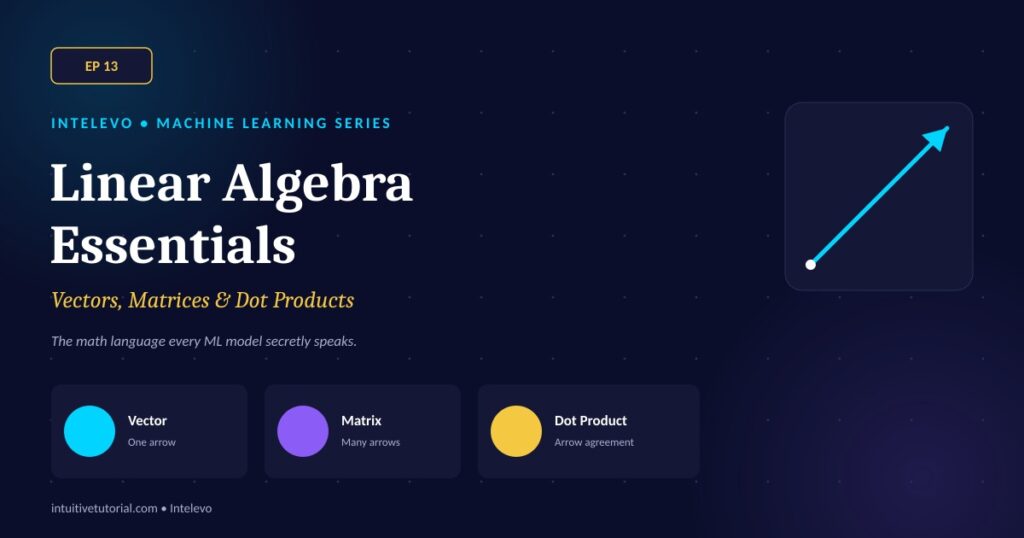
The Three Building Blocks, Side by Side
Before we move on, let’s line up all three ideas for a quick comparison:
- Vector — A list of numbers. Think of it as one arrow. In one line: direction plus distance.
- Matrix — A grid of vectors. Think of it as many arrows, working as a machine. In one line: it reshapes other vectors.
- Dot Product — One number from two vectors. Think of it as a measure of how well two arrows agree. In one line: it’s the heart of every prediction.
Together, these three ideas form the entire toolkit behind linear algebra for machine learning. Nothing extra, nothing hidden.
Quick Gut-Check: Does It Click Yet?
Try this scenario. A recommendation engine compares your taste vector to a new movie’s vector. The dot product comes back near zero. What does that tell you?
Pause for a second and think it through.
The answer: your tastes barely align with that movie. A dot product near zero means the two vectors point in almost unrelated directions, so the match is weak. If this answer felt intuitive, then the ideas in this article have already clicked into place.
This Math Is Already Around You
Linear algebra for machine learning isn’t some abstract classroom exercise. It runs quietly behind apps you already use every day.
- Recommendation engines: Your taste vector gets compared, through dot products, against every available item, then results get sorted by score.
- Photo filters: A matrix multiplies every pixel vector to shift color, blur an image, or sharpen the details.
- Search engines: Your query becomes a vector, and the engine matches it against web pages using the dot product.
- Voice assistants: Sound waves turn into vectors, and matrices transform them, step by step, into recognized words.
Each of these systems relies on the same three ideas you just learned. Once you notice them, you can’t unsee them.
Common Questions About Linear Algebra for Machine Learning
Do I need calculus before I learn linear algebra for machine learning? No, not for these three ideas. Vectors, matrices, and dot products only need arithmetic. Calculus becomes useful later, once you study how models improve through gradient descent, but you can understand today’s concepts without it.
Is NumPy required, or can I use plain Python lists? Plain lists technically work, but NumPy makes everything faster and cleaner. It also matches the style you’ll see in real ML libraries like scikit-learn and PyTorch, so it’s worth learning early.
Why do machine learning courses make linear algebra look so hard? Most courses start with formal notation before building intuition. This article, and the companion video, flip that order on purpose. Once you picture vectors as arrows and matrices as machines, the formal notation becomes far easier to read.
What You’ve Learned Today
Let’s recap quickly, because repetition helps these ideas stick.
First, you learned the three building blocks: vectors, matrices, and dot products. Next, you understood why a vector is simply a list, and why a matrix is simply a grid of them. After that, you saw simple NumPy code turn each idea into a single, working line. Finally, you connected the dot product straight back to model.fit() and model.predict(), the two functions that felt mysterious just a few episodes ago.
None of this required a single intimidating formula. That’s the whole point of linear algebra for machine learning, once you strip away the jargon: it’s just arrows, grids, and agreement scores, working together.
Watch the Full Video and Learn Along
This article covers the same journey as the EP13 video at our youtube channel Intelevo , so pair the two together for the best result. Watch the video first to hear the analogies in context, then return here anytime you want to review the code or refresh a specific concept.
If this breakdown of linear algebra for machine learning helped things click, please like the video, subscribe to Intelevo, and leave a comment with your thoughts or questions. Your feedback shapes future episodes, and I read every single comment.
Coming Up Next: Statistics Refresher
In Episode 14, we shift from linear algebra to statistics. We’ll cover mean, variance, and distributions, explained with the same simple, no-formula approach you just experienced here. These numbers describe your data at a glance, and once you learn them, you’ll read any dataset with far more confidence.
Until then, keep practicing with vectors, matrices, and dot products. The more you use them, the more natural they become, and the closer you get to truly understanding how machine learning works under the hood.
This article accompanies the Intelevo YouTube video “EP13: Linear Algebra Essentials.” For more simplified machine learning tutorials, visit intuitivetutorial.com.