
Artificial Intelligence in Autonomous Systems
Autonomous AI
Artificial Intelligence in Autonomous Systems Read More »
The Center for Brains, Minds and Machines (CBMM) is a premier institute and NSF Science and Technology Center dedicated to the study of intelligence. The website and Youtube channel of the institute contains a good number of tutorials and educational materials that help anyone interested in topics related to neuroscience, machine intelligence, etc. One of
RL Tutorial from Center for Brains Minds and Machines Read More »
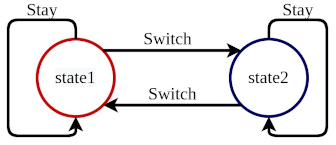
A Markov Decision Process (MDP) is a mathematical framework used to model decision-making situations where the outcome of a decision depends on both the current state of the system and the actions taken by the decision maker. In an MDP, the decision maker is represented as an agent, and the system is represented as a
Coding a Simple Markov Decision Process Read More »

Bellman operators come in Reinforcement Learning (RL). When I first encountered it, I had many questions regarding it. I often feel it is interesting to observe that what feels intriguing to someone. Many questions surface out in our minds. Why is it called an operator?. What are the inputs to it and output from it?.
A conceptual look at Bellman operator Read More »
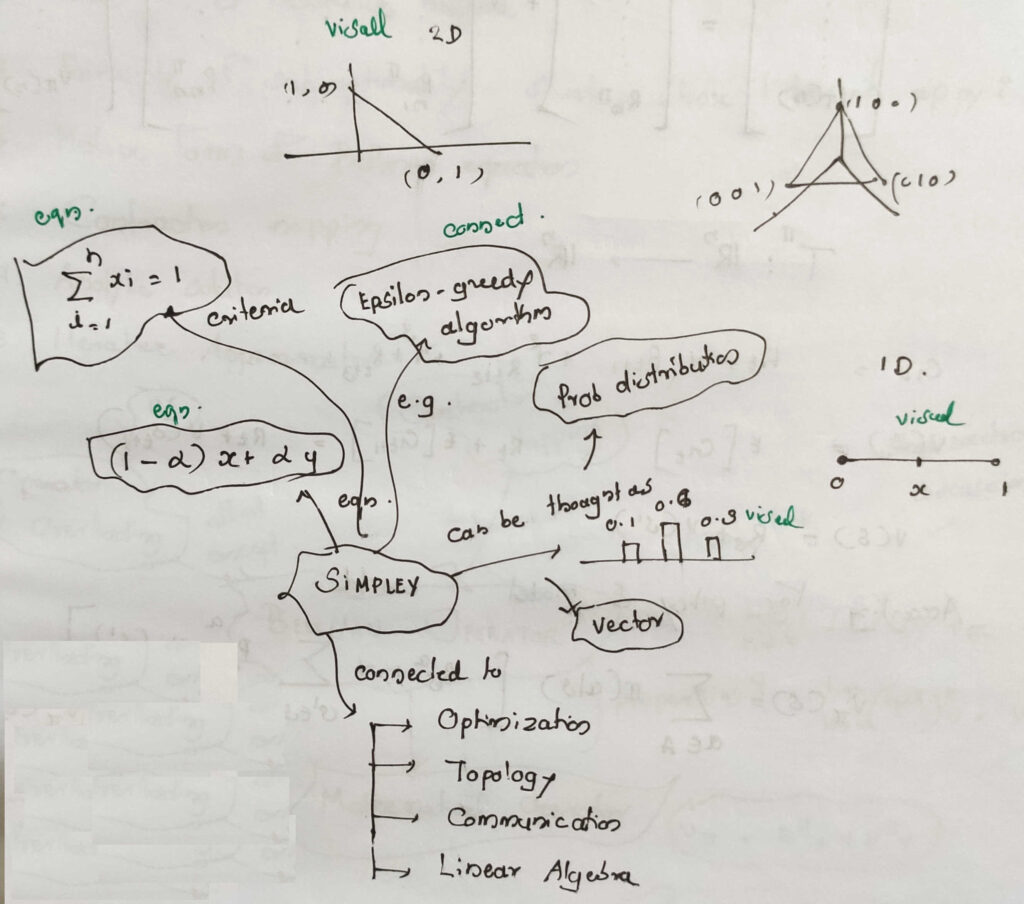
The concept of simplex appears in science and engineering over and over again. For example it appears in optimization, information theory, communication systems, linear algebra, etc. Let’s have a quick look at it from different contexts. In general, simplex can be thought of as a mathematical expression of $\alpha x + (1-\alpha)y$. It can be
Simplex explained in one minute Read More »
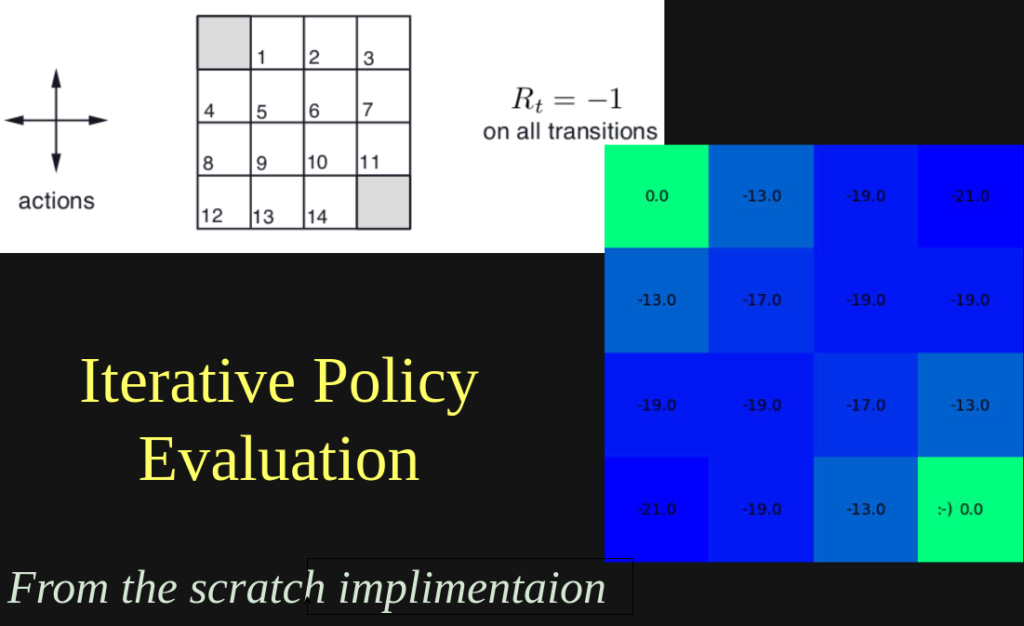
Introduction In this tutorial, I am going to code the iterative policy evaluation algotithm from the book “Reinforcement Learning: An Introduction by Andrew Barto and Richard S. Sutton”. I am going to take psuedo code, image and examples from this text. The example I am taking for this tutorial is the gird world maze from Chapter
Iterative Policy Evaluation for Estimating Value Function Read More »

In summertime when I go out, I don’t take the raincoat with me. On what basis am I not expecting it to rain during summer?. Isn’t it my past experience gives me that knowledge and estimate the outcome?. The expected value in probability theory leverages such a pattern in data to make a good representation
Introduction Iterative Policy Improvement (IPI) is an algorithm in reinforcement learning to find the optimal course of action given the enviroment conditions. This blog post explains how it is done using a simple grid world navigating example. It works by iteratively improving an initial policy using the policy evaluation and policy improvement steps. Here’s how
Iterative Policy Improvement Read More »
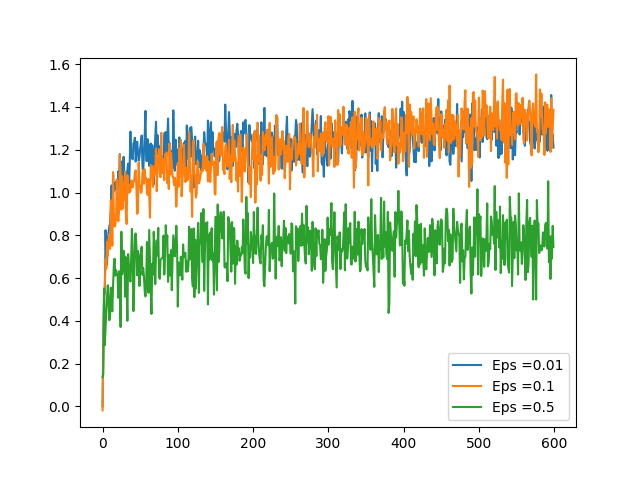
Introduction Bandit problems are the simplest possible reinforcement learning scenario. Here the bandit machine can have k arms and pulling each arm leaves the user a reward. One of the arms will be giving higher rewards in the long run and moreover this pattern could be changing over a time period. Think of the scenario
Epsilon Greedy Algorithm in Bandit Problems Read More »